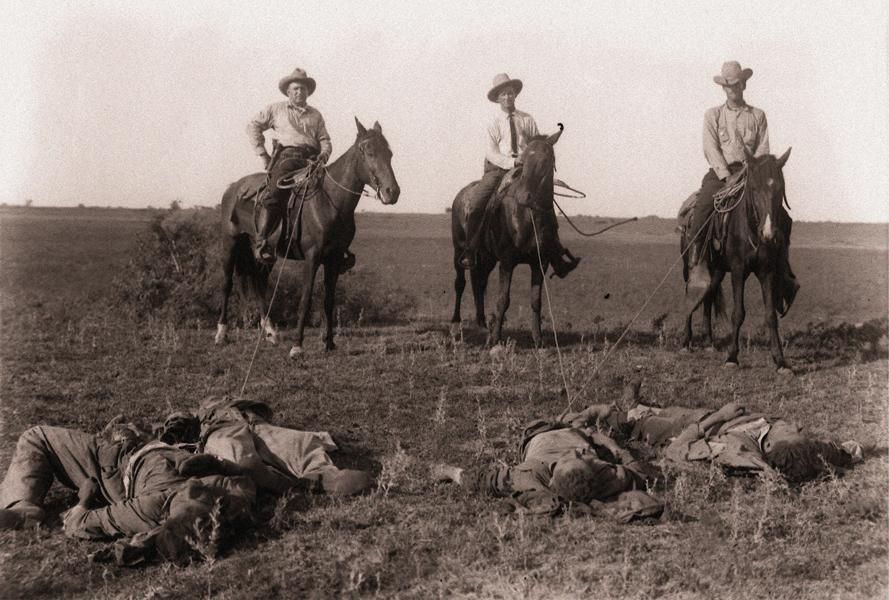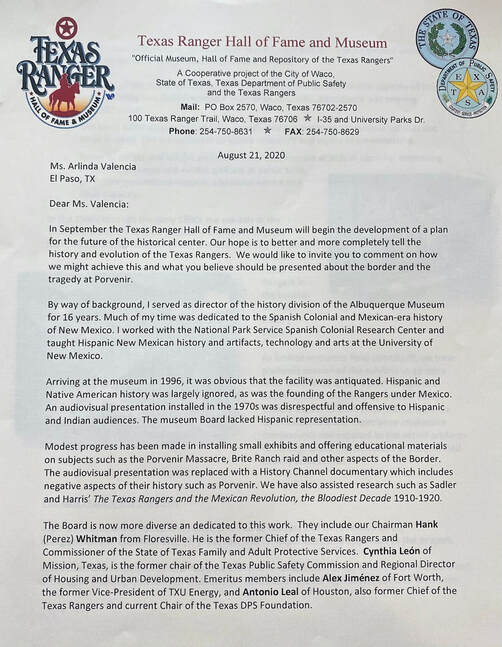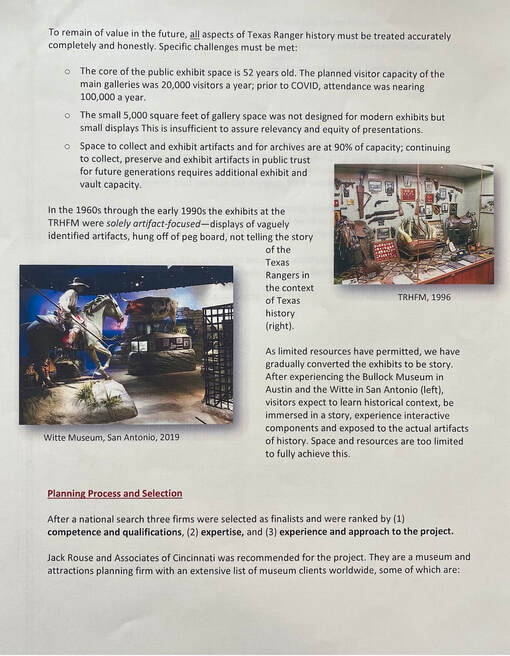
This site is dedicated to the descendants of the 15 men and boys who were murdered at Porvenir, Texas, in 1918 by Texas Rangers and local ranchers.
Creator and Editor: Arlinda Valencia (Great-Granddaughter of Longino Flores)
TexasMonthly
Trump’s Border-Wall Construction Is Set to
Bulldoze a West Texas Historic Site.
By Peter Holley August 7, 2026
Arlinda Valencia was in her fifties when she found out, for the first time, that her great-grandfather, Longino Flores, had been gunned down alongside fourteen other unarmed men in the West Texas desert on a cold January night in 1918. Like so many descendants of those killed in the Porvenir massacre, she knew almost nothing about one of the most reprehensible events in Texas history. For much of the twentieth century, the massacre was absent from school history books and repressed by family members, many of whom spent decades battling emotional wounds that today would likely be characterized as symptoms of post-traumatic stress disorder. Meanwhile, the Texas Rangers—who are widely considered responsible for the racially motivated executions, alongside members of the U.S. Army and local vigilantes—would become almost mythical symbols of frontier law and justice.
In 2018, after decades of research and lobbying, Valencia, alongside hundreds of other descendants, succeeded in getting the Texas Historical Commission to erect a marker documenting the atrocity. Family members commemorated the occasion with a four-hundred-person reunion at the state capitol, a triumph that was captured in a documentary film that aired nationally on PBS. “Some people will look at Porvenir and they’ll say it’s just empty desert,” said Valencia, 74, who is retired and lives in El Paso. “No, it’s not. You’ve got to remember, it’s a historic landscape, an archaeological site, and a sacred place for the descendents of the massacre, and it has taken decades for us to get the public to understand what happened there.”
What took a century to officially uncover could be on the verge of disappearing, once again, into the rugged scrubland of the Chihuahuan Desert. In recent weeks, locals say, the Trump administration has accelerated its plan to construct a border wall along a desolate and inhospitable stretch of the Rio Grande in Presidio County about two hours southwest of Marfa. Based on analyses of U.S. Customs and Border Protection’s “Smart Wall Map,” the thirty-foot-tall steel wall would cut off access to the Porvenir massacre site, and the barrier’s construction, many fear, would bulldoze what remains of the sensitive archaeological zone, which is still being studied.
For Valencia and other descendants—many of whom want to be able to continue visiting Porvenir each year to pay their respects to the victims—the potential destruction of the site isn’t just a desecration of Texas history and the disruption of “a hundred-year-old crime scene,” as Valencia puts it. It’s also a crushing insult to the dozens of families with relatives connected to the massacre. “Do you think if you started bulldozing Gettysburg that people would accept it?” Valencia said. “Of course not. People died there—it’s sacred land.” The Department of Homeland Security, which manages border-wall construction through Customs and Border Protection, utilizing private contractors and congressional funding, did not respond to Texas Monthly’s specific inquiries about the Porvenir site and the potential impact of the border wall. But in a statement emailed to the magazine, a CBP spokesperson said the agency sought public input about the border wall’s impact on the local environment, culture, and quality of life between February and May. “At this time, the route has not been finalized, however, CBP utilizes feedback from the public outreach period to compile best management practices for construction . . . to avoid or minimize impacts to the environment to the greatest extent possible, while still meeting the Border Patrol’s operational requirements,” the statement reads.
The Porvenir massacre took place during a period known as La Matanza (the Slaughter), a years-long wave of systematic racial terror and extrajudicial killings of ethnic Mexicans along the U.S.-Mexico border by law enforcement and vigilantes, many of whom were intent on pushing Hispanic landowners off their properties between 1910 and 1920 with extreme violence. On January, 28, 1918, Porvenir, a sleepy farming village along the Rio Grande, was targeted by a gun-wielding mob made up of Texas Rangers from Company B, members of the U.S. Army, and local ranchers.
The group, which was under the command of Captain James Monroe Fox, dragged fifteen villagers—two teenage boys and thirteen men, all ethnic Mexicans—from their beds and accused them of partaking in the raid of a nearby ranch weeks earlier. Despite a lack of evidence linking the villagers to the raid, the Porvenir residents were marched to a nearby rock formation and summarily executed. The victims’ bodies were left where they where shot, though they were eventually buried on the Mexican side of the border. The victims’ families abandoned their homes and fled, many to Mexico. No Texas Ranger was ever prosecuted, indicted, or legally convicted for his role in the mass murder, according to the Texas State Historical Association.
The Porvenir site, and the importance of its preservation to many in the Big Bend community, should be well-known to the CBP. David Keller, a West Texas archaeologist and historian known for leading the archaeological project on the Porvenir massacre, emailed a letter to DHS in May, during that same public-comment period for the Big Bend area, labeling the site “one of the most historically significant and sensitive sites in the U.S.-Mexico borderlands.” The letter also outlined the fraught regional history and the findings of Keller’s 2015 excavation, which relied on metal detectors and ballistics and a small team of experts to uncover military-issue cartridge casings at the execution site—a discovery that challenged the historical narrative that the killings were done solely by local vigilantes and Texas Rangers. “There was basically a massive coordinated cover-up to conceal the reality of what happened that night, because as you know, what we found on the ground implicated the military in a huge way,” Keller said. “We finally get some acknowledgement that this happened, and now they’re going to basically erase it from the books of history. It’s an egregious thing.”
As Keller noted in his letter to DHS, the site retains “unusual archaeological integrity.” That’s because the massacre location lies within an area where an ancient volcanic formation trapped a type of light, sandy sediment that helped preserve artifacts from the massacre for over a century. Though most of the artifacts were removed from the site and cataloged during the 2015 excavation, Keller said, construction activity—which disturbs soils and increases erosion—could destroy those “archaeological deposits” that remain.
There’s a good chance that’s already happened. Keller, who has traveled to the site and spoken to a contractor about construction plans in recent days, said the newly built roadway, which he estimated to be about sixteen feet wide, currently cuts through the eastern third of the archaeological site, which has already been run over with heavy machinery. Local residents and officials have mapped the roadway and documented a series of survey stakes that follow it on the ground. Those stakes, they say, appear to align with the wall on CBP’s Smart Wall Map, leaving little doubt that wall construction will cut through the Porvenir site.
Though the primary part of the site, which sits against a rust-colored outcropping where the executions took place, hasn’t been directly impacted, Keller said he expects that will change if border-wall construction continues. “It’s our understanding, based on talks between contractors and local officials, that the sixteen-foot-wide path is going to be widened to one hundred or one hundred and twenty feet to accommodate the wall, lighting, and multiple access roads,” he said, adding that the site will essentially be hidden behind a wall that practically cedes everything on the other side, including the Rio Grande, to the Mexican side of the international border. “It’s deeply disturbing to me, and it’s very personal, but I can’t even imagine what it’s going to mean to the descendants of the victims as they find out.”
On a recent morning, I traveled to the Porvenir site with Susan Hays, an incoming Presidio County commissioner and a lawyer and local organizer who, alongside a loose network of activists, environmental experts, archaeologists, and local officials across the political spectrum, is fighting the border-wall construction. Though the perception outside the region is that the wall feels inevitable, Hays indicated that that’s not the feeling on the ground. “There are a lot of smart, wealthy, and educated people out here who chose to move here or have a second home out here, and they’re prepared to fight back,” she said. “You have billionaires who are Republican donors and don’t like this idea of walls on their land.” “This whole thing is a war of attrition,” Hays added. “It’s a matter of who can wear out the other side first.”
The day before, Hays had managed to track down the family of the deceased owner of the land that the Povenir site sits on, a man who lives in Louisiana and was, she said, unaware of both the history of the massacre and the fact that the government intended to build a wall across his property. “I was worried he might not care about the history, but he was fascinated and indicated that he understood the importance of preserving the site,” she said. Hays later determined that the widow had granted the government permission to access the land via a “right of entry” letter, which allows for entry and surveying with notice to the landowner, but was unaware that a road would be built on it or of what activities might take place there. She also was not notified before the work began. “I think this person may have been hoodwinked,” Hays said. Getting to the Porvenir site, which is located near Chispa Road, is an arduous task that involves navigating steep, rocky bends along the unstable dirt road, sand traps capable of turning to thick mud in a rainstorm, and the ever-present threat of being stranded in the unforgiving landscape due to vehicle trouble.
Hays, who has attended meetings with government officials and contractors in recent months, said she’s certain that the government intends to build a wall through the Porvenir site and across much of the surrounding land. “There’s a map of their plans online, but they have refused to meet with the public,” she said. “There have been some furtive meetings with local officials.” At multiple points along the journey, she showed me signs of border-wall construction that was already well underway: heavy equipment parked beside the road, survey stakes poking from the ground, and giant tire tracks on vast tracts of land buttressing the Rio Grande. On some giant rock faces, locals had used small rocks to form ten-foot-tall messages that couldn’t be avoided by contractors driving past: “F— the border wall,” they read. At one point, after embarking on foot, Hays showed me a part of the floodplain, formerly covered in dense foliage that was home to innumerable forms of wildlife, that looked like it had been flattened by a steamroller, crushing ancient trees and plant life in the process. The destruction, more than a hundred yards wide, more closely resembled the aftermath of a natural disaster than a construction zone. Hays said she also saw an economic disaster—one at odds with the very culture of the Big Bend region. “The lavish expenditure of money for a wall that people don’t need when we can’t maintain our roads and people don’t have access to basic health care out here, it enrages people,” she said. “The wall-construction machine feels like a king wearing gilded clothing walking through a crowd of starving people.”
A few miles down the road, we arrived at the Porvenir site, which is easily camouflaged by the dense scrubland and the vast, undulating landscape that surrounds it. After crossing the newly constructed road that cuts through the site, I walked over to the rocky outcropping where the executions took place, the ones that left bullet-riddled bodies unrecognizable, witnesses later reported, sidestepping sharp desert shrubs and cacti along the way. There was little to indicate that a mass murder had taken place there besides a bright yellow bundle of plastic flowers wedged into the rock and several pieces of bleached plywood with the names of victims scrawled on them: “Pedro,” “Roman,” “Antonio.” The site was heavy and more than a little eerie, its history almost palpably preserved by the desolate environment, the parched desert air, and a stillness that felt more like an echo than a form of serenity. When I reached Valencia by phone the next day, she said she felt it too during her visit to the site. ”If you stand there and just listen to the silence, it’s just . . . I don’t know how to explain it,” she said. “It’s not the typical silence that you would find anywhere else. It’s like the land still knows what happened there, and now we do too.”
|